Real vs Fake Lapis Lazuli
Worried your Lapis Lazuli might be fake? Here’s how Lapis Lazuli is imitated and the quick checks that tell the real thing apart — no lab needed for a first pass.
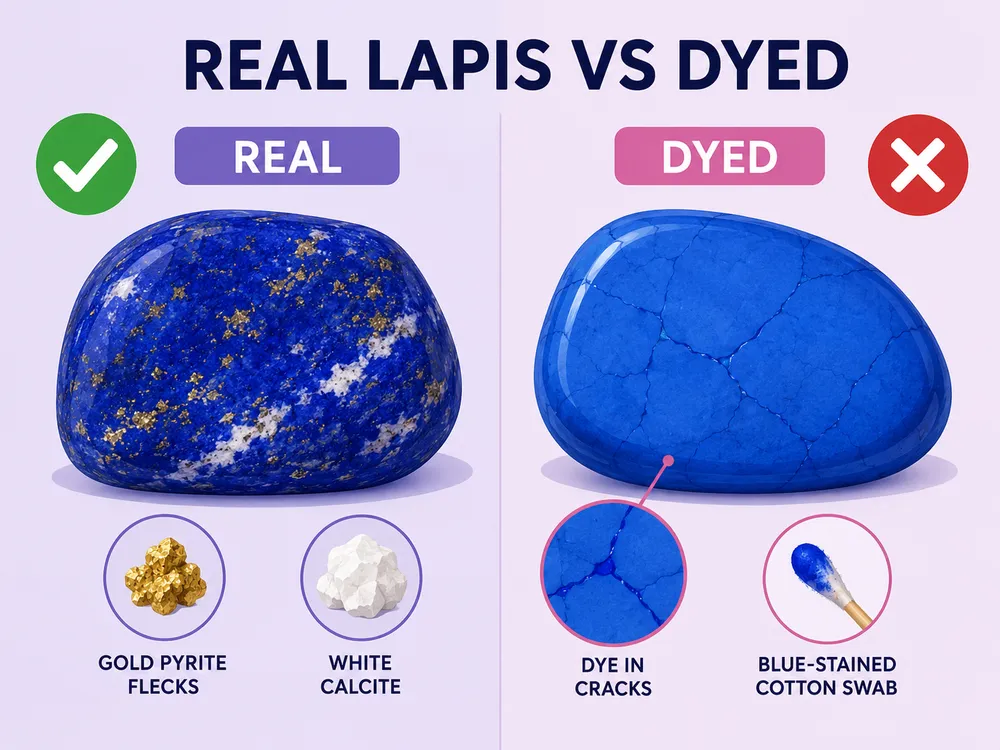
How Lapis Lazuli is faked
The usual imitations: dyed howlite or jasper ("Swiss lapis" is dyed jasper), dyed calcite, and reconstituted powder + resin.
Real vs fake Lapis Lazuli at a glance
| Genuine Lapis Lazuli | Imitation | |
|---|---|---|
| Pyrite | Real metallic gold flecks | Painted on or absent |
| Calcite | White patches | Too-uniform blue |
| Dye | None | Rubs off with acetone |
How to tell real Lapis Lazuli
- Real lapis carries natural gold pyrite flecks (metallic, not painted) and patches of white calcite; painted-on "gold" is a fake.
- Dye rubs off on an acetone-dampened cotton bud, and the blue is often too uniform.
- Reconstituted lapis looks too perfect and even; natural lapis varies across the stone.
Lapis Lazuli guide

Frequently asked questions
How do you spot fake lapis lazuli?
Genuine lapis has natural pyrite (real metallic gold flecks) and some white calcite, with uneven blue. Dyed howlite/jasper has painted or absent pyrite, dye that rubs off with acetone, and a suspiciously uniform colour.
What is Lapis Lazuli worth?
Real Lapis Lazuli and its imitations differ a lot in value — see the value guide. Imitations (glass, dyed or reconstituted material) are worth a small fraction of the genuine stone.