Real vs Fake Moonstone
Worried your Moonstone might be fake? Here’s how Moonstone is imitated and the quick checks that tell the real thing apart — no lab needed for a first pass.
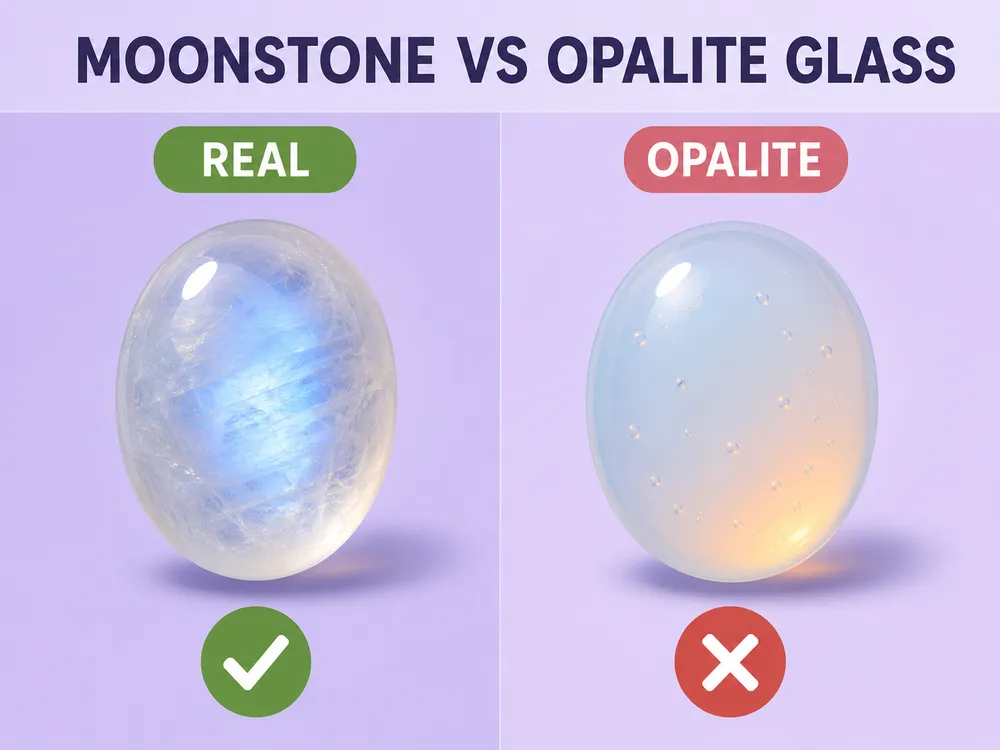
How Moonstone is faked
The usual imitations: opalite and frosted/milky glass sold as moonstone.
Real vs fake Moonstone at a glance
| Genuine Moonstone | Imitation | |
|---|---|---|
| Sheen | Floats from within (adularescence) | Static, surface-level |
| Transmitted light | Translucent white | Opalite glows orange |
| Material | Feldspar, fine cleavage | Glass, round bubbles |
How to tell real Moonstone
- Real moonstone's blue-white sheen (adularescence) appears to float and shift from inside as you tilt it; glass glow is static and surface-level.
- Opalite glass shows an orange glow in transmitted light and a flat blue in reflected light, often with round bubbles.
- Real moonstone is feldspar (Mohs ~6) and may show fine cleavage lines; glass has none.
Moonstone guide

Frequently asked questions
Is moonstone or opalite real?
Real moonstone shows adularescence — a blue-white sheen that floats and moves from within the stone. Opalite (glass) has a static glow, turns orange in transmitted light, and often contains bubbles.
What is Moonstone worth?
Real Moonstone and its imitations differ a lot in value — see the value guide. Imitations (glass, dyed or reconstituted material) are worth a small fraction of the genuine stone.