Real vs Fake Opal
Worried your Opal might be fake? Here’s how Opal is imitated and the quick checks that tell the real thing apart — no lab needed for a first pass.
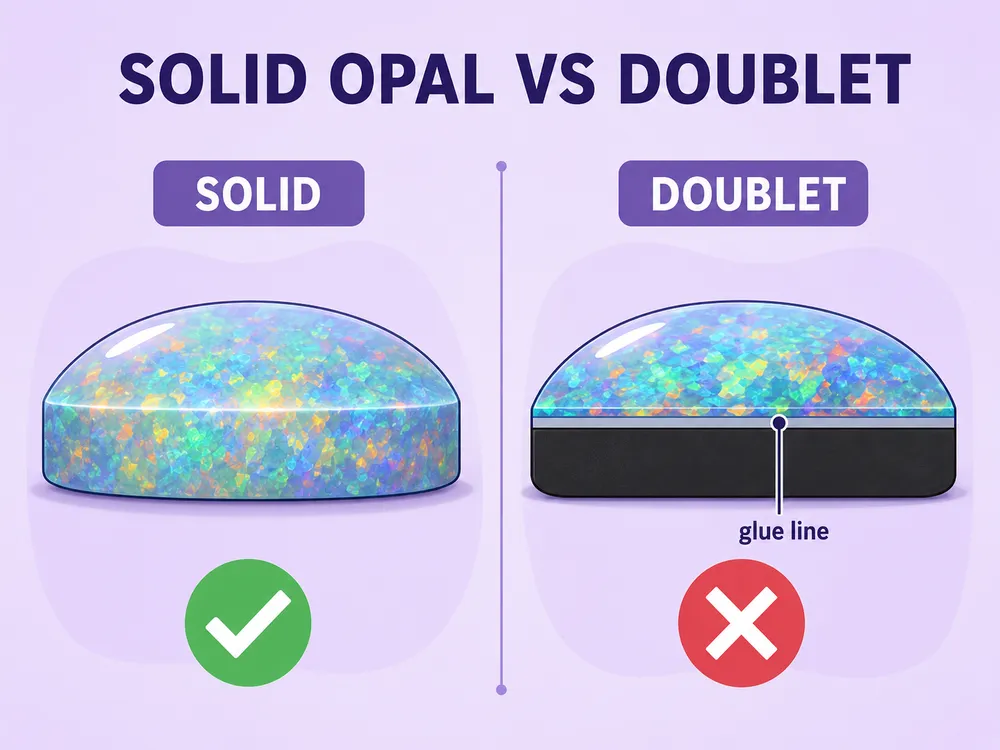
How Opal is faked
The usual imitations: doublets and triplets (a thin slice of opal glued to a dark backing, sometimes capped with quartz), synthetic (Gilson) opal, and glass/plastic "opalite".
Real vs fake Opal at a glance
| Genuine Opal | Imitation | |
|---|---|---|
| Side view | Colour through the body | Flat join + dark backing (doublet) |
| Pattern | Irregular play-of-colour | Regular "snakeskin" (synthetic) |
| "Opalite" | — | Just glass, no true play |
How to tell real Opal
- View from the side: a doublet/triplet shows a dead-flat join and a black backing; solid opal has colour through its body.
- Synthetic opal shows an unnaturally regular "snakeskin"/columnar pattern; natural play-of-colour is irregular.
- "Opalite" is just milky glass — it has a flat blue-orange glow, not true flashing play-of-colour.
Opal guide

Frequently asked questions
How do you spot a fake or doublet opal?
Look at the stone edge-on: doublets and triplets reveal a flat glue line and dark backing. Synthetic opal has a too-regular columnar pattern, and "opalite" is glass with no real play-of-colour. Solid natural opal shows colour throughout its body.
What is Opal worth?
Real Opal and its imitations differ a lot in value — see the value guide. Imitations (glass, dyed or reconstituted material) are worth a small fraction of the genuine stone.