Real vs Fake Turquoise
Worried your Turquoise might be fake? Here’s how Turquoise is imitated and the quick checks that tell the real thing apart — no lab needed for a first pass.
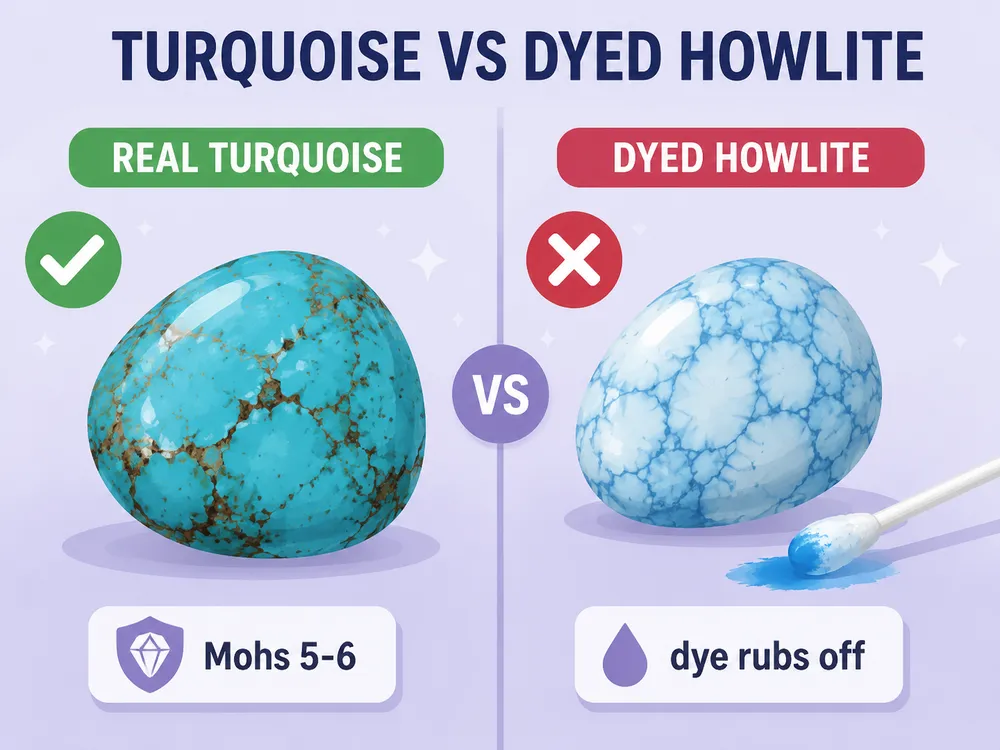
How Turquoise is faked
The usual imitations: dyed howlite or magnesite, reconstituted (ground-up turquoise + resin) and dyed plastic.
Real vs fake Turquoise at a glance
| Genuine Turquoise | Imitation | |
|---|---|---|
| Hardness | Mohs 5–6 | Howlite ~3.5, scratches easily |
| Colour | Natural matrix | Dye pooled in cracks |
| Feel | Cool, dense | Plastic: warm, light |
How to tell real Turquoise
- Howlite is much softer (Mohs ~3.5 vs turquoise 5–6) and its veining is grey-black; dye often rubs off on a cotton bud with acetone.
- Reconstituted/plastic feels light and warms quickly in the hand; real turquoise feels cool and denser.
- Dye pooling in the cracks and a too-uniform electric blue are red flags.
Turquoise guide

Frequently asked questions
How do you tell real turquoise from dyed howlite?
Howlite is softer (scratches easily), naturally white with grey veins, and its dye often rubs off with acetone. Real turquoise is harder, cooler to the touch and its matrix is part of the stone, not surface dye.
What is Turquoise worth?
Real Turquoise and its imitations differ a lot in value — see the value guide. Imitations (glass, dyed or reconstituted material) are worth a small fraction of the genuine stone.